ANNA FREBEL
Astrophysicist, Speaker & Author

Searching for the Oldest Stars
Anna Frebel’s research interests broadly cover observational stellar astrophysics. She is also currently head the Astrophysics Division at MIT.
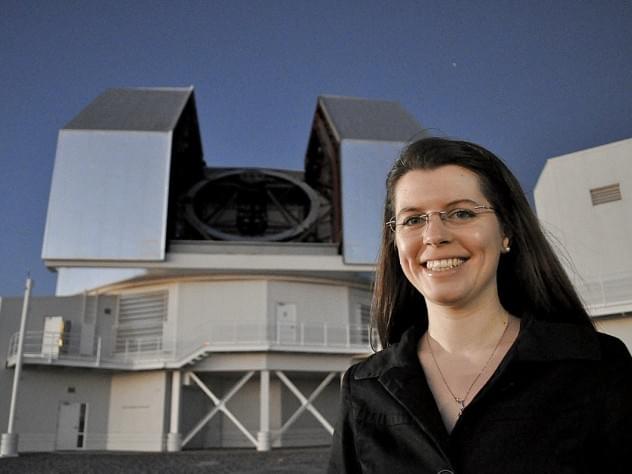
For nearly 25 years, Anna has been chasing some of the oldest stars in the universe, using mostly the 6.5 meter Magellan Telescopes in Chile
Anna's publication record
Stellar Archaeology
Using the oldest stars to uncover the earliest chapters of cosmic history
Some of the oldest stars in the Milky Way have been shining for more than 12 billion years. Because these low-mass stars preserve the chemical composition of the gas from which they formed, their atmospheres contain a fossil record of conditions in the early universe. Through high-resolution spectroscopy, Anna and her group measure these chemical fingerprints and use them to reconstruct the properties of the first stars, their supernova explosions, and the earliest stages of chemical enrichment.
The most chemically primitive stars can bring us remarkably close to individual events in the young universe. For example, the abundance pattern of the iron-poor stars HE1327−2326 and SMSS J0313−6708 could each be explained by enrichment from a single low-energy first-generation supernova.
Stellar archaeology thus allows us to investigate stars that disappeared more than 13 billion years ago by studying the surviving stars that formed from their ashes.
Selected scientific papers:
Stellar Archaeology — Exploring the Universe with Metal-Poor Stars
A single low-energy, iron-poor supernova as the source of metals in SMSS J0313−6708
Nuclear Astrophysics
Tracing the cosmic origins of the chemical elements
Where did the elements in the Periodic Table come from? Ancient stars provide a unique laboratory for answering this question. Their elemental abundance patterns preserve the signatures of nucleosynthesis in earlier generations of stars and stellar explosions, allowing us to connect nuclear processes on the scale of atomic nuclei to events occurring in stars, supernovae, and neutron-star mergers.
A major focus of Anna's work has been the origin of the heaviest elements produced by the rapid neutron-capture, or r-process. The discovery that stars in the tiny ancient galaxy Reticulum II contain enormous enhancements of r-process elements showed that a single, rare event enriched this entire early galaxy—providing important evidence that events such as neutron-star mergers can produce elements including europium, silver, gold, and platinum.
Other work uses r-process-enhanced stars to probe the production of the actinides and even radioactive uranium and thorium to measure stellar ages.
Selected scientific papers:
R-process enrichment from a single event in an ancient dwarf galaxy — Nature
Actinide-rich and Actinide-poor r-Process Enhanced Metal-Poor Stars
Discovery of HE 1523−0901, a strongly r-process enhanced star with detected uraniumNear-Field Cosmology
Using our cosmic neighborhood to understand the first galaxies
We normally think of cosmology as looking billions of light-years away.
Near-field cosmology does the opposite: it searches our own Milky Way and its neighboring dwarf galaxies for surviving relics of the early universe. The motions, locations, ages, and chemical compositions of their oldest stars allow us to reconstruct how the first small galaxies formed and how systems like the Milky Way were subsequently assembled.
Ultra-faint dwarf galaxies are particularly valuable because many contain almost exclusively ancient, chemically primitive stars and may represent surviving examples of some of the universe's earliest galaxies. Anna's group's work has used their stars to investigate early chemical enrichment and galaxy formation—for example, discovering that the ancient dwarf galaxy Tucana II possesses a remarkably extended stellar and dark-matter halo.
Closer to home, chemo-dynamical studies of metal-poor stars can identify ancient components and accretion events preserved within the Milky Way itself, such as the metal-poor “Atari Disk.”
Selected scientific papers:
Near-Field Cosmology with Extremely Metal-Poor Stars
An extended halo around an ancient dwarf galaxy — Nature Astronomy
The Atari Disk, a Metal-Poor Stellar Population in the Milky Way


©2026